Every Sunday, we publish a fast, signal‑dense briefing on the biggest shifts in AI, jobs, and builders. If you want this in your inbox, Join the Sunday Special.
In 2026, AI job exposure stopped being a thought experiment and quietly became a hiring filter, a workflow layer, and a new kind of manager.
Anthropic just mapped where that AI job exposure is highest, OpenAI pushed agents closer to credible desktop operators, and McKinsey sketched how organizations might actually absorb all of this.
Taken together, they don’t say “AI will replace everything.” They tell a more useful story: work is being reorganized unevenly, and the leverage is up for grabs.
Anthropic’s new Claude Ambassador Program adds a builder-level layer to that map, giving people who host meetups or ship with Claude a front-row seat to these shifts.
This isn’t about abstract automation risk. It is about which tasks are getting compressed first, which workflows compound fastest, and which people gain an unfair advantage by adapting early.
1. Anthropic’s AI job exposure metric: where compression starts
Anthropic’s new labor-market study introduces observed exposure, a way to measure not what AI could do in theory, but which job tasks are already being automated in real workplaces.
By combining O*NET task data with usage from the Anthropic Economic Index, the study finds that some roles are clearly more exposed than others. Among the most exposed are computer programmers, customer service representatives, data-entry keyers, medical record specialists, and market research or marketing analysts.
These are not just theoretically automatable jobs. They already contain structured, repeatable digital work that AI handles well.
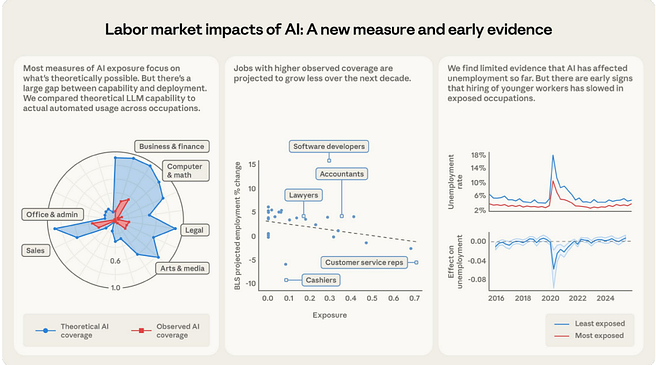
Anthropic does not find a broad unemployment spike in these occupations since ChatGPT launched. But it does find an earlier and subtler signal: hiring into the most exposed roles has slowed, especially for younger workers. For 22–25-year-olds, entry into highly exposed jobs has fallen enough to suggest roughly a 14% drop in hiring rates versus 2022.
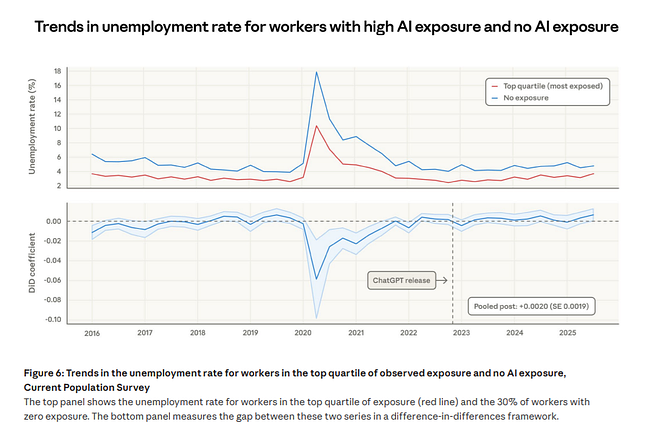
That nuance matters. AI disruption is not arriving first as mass layoffs. It is arriving as uneven workflow compression, visible in slower hiring and narrower entry points.
That shifts the real question from:
“Is my whole job safe?”
to:
“Which parts of my week are repetitive, well-specified, and easy to hand off to AI?”
The more your work depends on judgment, trust, synthesis, and coordination, the more durable it becomes. Anthropic’s metric helps readers see that shift as a signal, not just a vibe.
2. GPT‑5.4 moves AI closer to a working layer
While Anthropic maps exposure, OpenAI is improving the mechanism doing much of the compressing.
GPT-5.4 is designed for professional, multi-step work: stronger long-context reasoning, more reliable tool use, and better agentic execution across workflows that need to run without constant babysitting.

That sounds like a standard model upgrade, but the more important shift is practical. GPT-5.4 is better at:
- planning before calling tools
- staying focused across longer tasks
- following structured instructions
- completing multi-step workflows with fewer random detours
In practice, that makes it less like a chatbot and more like a working layer on top of your tools.
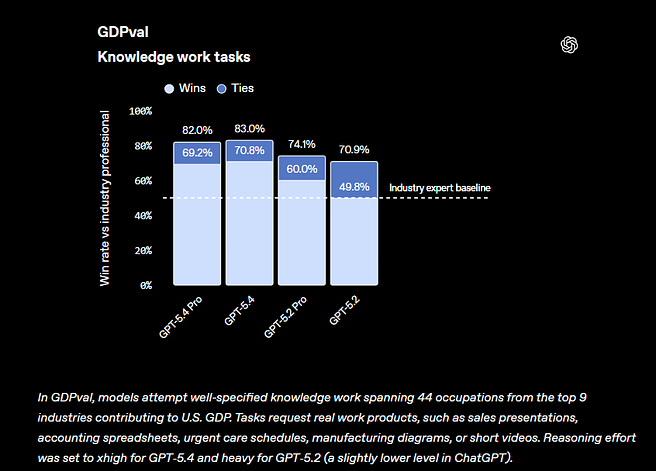
Instead of asking one-off questions, users can hand off workflows that touch documents, datasets, tickets, or multiple systems and get back a usable draft, brief, or output.
That is why “agent-first workflows” matters. The user skill that becomes valuable is no longer just prompt phrasing. It is defining goals, constraints, and success criteria clearly enough for AI to execute.
And that connects directly back to Anthropic’s exposure map: the tasks with the highest observed exposure are exactly the kinds of structured digital tasks GPT-5.4-style agents are getting better at absorbing.
3. McKinsey’s hybrid lens: people, agents, and robots
If Anthropic gives us the exposure map and GPT-5.4 upgrades the tool layer, McKinsey offers the org-design lens.
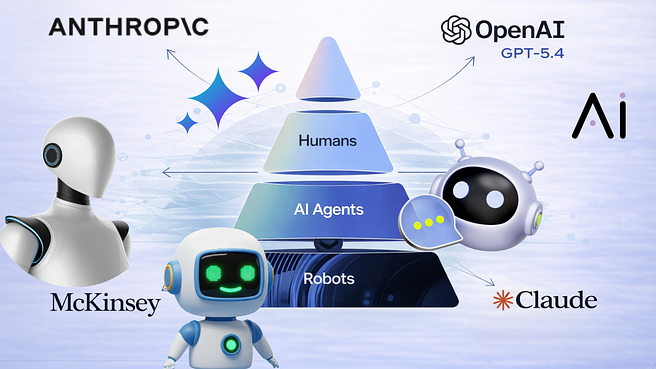
Its analysis argues that the future is not best understood as humans versus machines, but as a system shared across people, agents, and robots.
A simple version of that model looks like this:
- Humans handle judgment, trust, narrative, and coordination
- Agents handle repeatable reasoning and digital execution
- Robots handle physical execution where it makes economic sense
McKinsey’s point is not that jobs vanish one-for-one. It is that work gets redistributed across layers.
From that perspective:
- Anthropic shows which parts of work are drifting into the agent layer
- GPT-5.4 expands what that layer can actually do
- McKinsey shows that human advantage shifts upward into orchestration, oversight, and decision-making
For builders, one practical on‑ramp into this human–agent layer is Anthropic’s new Claude Ambassador Program, aimed at people already hosting meetups, leading workshops, or building with Claude in public.
So the most useful career question in 2026 is not:
“How do I avoid AI?”
It is:
“How do I move more of my value into judgment, coordination, narrative, and system design while learning to use agents as force multipliers?”
Reading the map before everyone else
Put Anthropic, GPT-5.4, and McKinsey side by side, and the picture gets much clearer.
Anthropic shows where AI is already compressing work. GPT-5.4 shows that agents are becoming more stable and useful inside real workflows. McKinsey shows that the end state is not total replacement, but hybrid systems built across humans, agents, and robots.
That turns “AI is changing work” into something actionable:
- Study exposure, not hype
- Build workflow leverage, not just prompt fluency
- Move toward judgment-heavy and coordination-heavy work
- Learn how to manage agents instead of competing with them directly
The people who benefit most from AI may not be the loudest online. They may be the ones quietly reading the map, redesigning their workflows, and moving themselves into the parts of the system that get more valuable as agents improve.
Uneven compression is already here. The earlier you learn to navigate it, the more options you keep.
This article is one signal. The Sunday Special tracks them every week.
🟣 AI events, learning paths, builder calls, and career shifts every Sunday.
👉 Join the Sunday Special — by TheAIEntrepreneurs Team