Every Sunday, we publish a fast, signal‑dense briefing on the biggest shifts in AI, jobs, and builders. If you want this in your inbox, Join the Sunday Special.
The enterprise AI race just entered a new phase. Not a model launch. Not a benchmark war. This week’s three signals are about infrastructure — the human, financial, and operational kind.

Anthropic is spending $100M to build a partner army. OpenAI is hiring 3,500 people to go enterprise-first. And McKinsey is telling real estate firms that the next productivity leap isn’t AI alone — it’s people, AI agents, and robots working as one system.
Each move tells a different part of the same story: AI is leaving the lab and entering the org chart.
1. Anthropic’s $100M Claude Partner Network: Building the enterprise distribution layer
The most important AI announcement this week wasn’t a model. It was a checkbook.
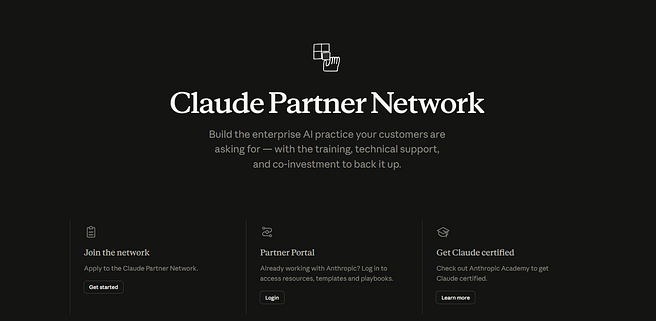
Anthropic committed $100 million to launch the Claude Partner Network — a structured program giving consultancies, AI firms, and enterprise service providers everything they need to take Claude from proof-of-concept to production deployment.
Why this matters for builders and operators:
$100M committed to partner training, sales enablement, and go-to-market development. This isn’t a marketing splash — it’s distribution infrastructure.
Claude Certified Architect (Foundations) — Anthropic’s first technical certification — is available today. This is the credentialing layer that turns “we use Claude” into “we’re certified to deploy Claude at scale.”
Anthropic is scaling its partner-facing team 5×, adding Applied AI engineers and technical architects. Translation: they’re building the human layer that makes enterprise deals close.
Partners get access to Anthropic Academy, sales playbooks, a Services Partner Directory, and a Code Modernization starter kit for migrating legacy codebases using Claude’s agentic coding capabilities.
The strategic read:
Anthropic looked at how Salesforce, AWS, and Microsoft built enterprise dominance and saw the same pattern: you don’t win enterprise with the best product alone. You win with the best partner ecosystem.
The asymmetric move for builders right now is to get certified early, before the partner directory is crowded. The firms that enter this ecosystem in Q1 2026 will have a structural advantage over those who show up in Q4.
2. OpenAI plans to nearly double headcount to 8,000
On the other side of the table, OpenAI is making a different bet on the same thesis: enterprise is the growth engine now.
According to the Financial Times, OpenAI is preparing to grow from roughly 4,500 employees to 8,000 by the end of 2026. The hiring surge follows a $110 billion valuation and is driven by one thing: enterprise adoption is now OpenAI’s fastest-growing segment.
What the hiring tells us:
Enterprise adoption is the priority. OpenAI is creating new “technical ambassador” roles — essentially embedded engineers who help companies integrate AI into real workflows. This is the same playbook Anthropic is running through partners, but OpenAI is doing it in-house.
The consumer-first era is over. ChatGPT made OpenAI famous. Enterprise contracts will make it profitable. The headcount surge signals a permanent shift in where the company sees its future.
Competition with Anthropic is accelerating. Both companies are now racing to build the enterprise distribution layer — Anthropic through partners, OpenAI through direct hires. Two strategies, same destination.
The blunt takeaway:
If you’re building on either platform, the next 12 months will bring more support, more tooling, and more integration help than ever before. The window to build relationships with these teams — while they’re still scaling — is right now.
3. McKinsey: The next productivity leap is people + AI agents + robots
McKinsey’s latest research draws a line that most AI coverage misses: the biggest gains don’t come from adding AI to existing workflows. They come from redesigning workflows around hybrid human-AI-robot systems.
The focus is real estate, but the pattern applies everywhere.
What McKinsey is actually saying:
AI agents take on scheduling, documentation, compliance, and tenant interactions. These aren’t hypothetical use cases — they’re the tasks that already consume 40–60% of operational time in property management.
Robots expand into inspections, maintenance, and facilities operations. Physical AI is no longer a demo reel. McKinsey sees it entering real workflows within 18 months.
Human roles shift toward judgment, coordination, and client relationships. The skills that compound with AI — negotiation, cross-functional problem-solving, high-stakes decision-making — become more valuable, not less.
Leaders who rethink end-to-end workflows see the largest lift. The companies layering AI on top of old processes get marginal improvements. The ones redesigning the process itself get transformational ones.
Why this matters beyond real estate:
Swap “real estate” for healthcare, logistics, legal, or financial services and the framework holds. The question isn’t “which tasks can AI do?” It’s “what does the workflow look like when people, agents, and robots each handle what they’re best at?”
That’s the redesign that separates incremental efficiency from structural advantage.
Why this trio matters
Taken together, these three signals sketch one coherent picture of where enterprise AI is heading in 2026:
Anthropic is building the partner army. $100M says they’re serious about making Claude the default enterprise AI platform — not through direct sales, but through an ecosystem of certified partners who deploy it.
OpenAI is building the in-house army. 8,000 employees, technical ambassadors, and enterprise-first hiring say they’re betting on owning the customer relationship directly.
McKinsey is drawing the map. The firms that win aren’t the ones that “use AI.” They’re the ones that redesign their operations around hybrid systems where people, agents, and robots each play defined roles.
What to do now:
→ If you’re a consultancy or AI firm: Get into Anthropic’s partner network early. Certification + directory listing = deal flow before the ecosystem is saturated.
→ If you’re building on OpenAI: The enterprise support layer is about to get dramatically better. Build relationships with the new technical ambassador teams as they scale.
→ If you’re an operator or leader: Stop asking “where can we add AI?” Start asking “what does this workflow look like if we redesign it from scratch with people, agents, and automation each in their optimal role?”
The companies that treat 2026 as a distribution and redesign year — not just a model upgrade year — will be the ones that pull ahead.
This article is one signal. The Sunday Special tracks them every week.
🟣 AI events, learning paths, builder calls, and career shifts — every Sunday.
👉 Join the Sunday Special — by TheAIEntrepreneurs Team