The biggest problem in precision oncology isn’t finding new drugs. It’s seeing what’s actually happening inside the tumor.
There’s a test called multiplex immunofluorescence — mIF — that maps how individual immune cells interact with cancer cells across dozens of protein channels. It tells oncologists whether a patient’s immune system is actively fighting the tumor or being suppressed by it. That information can determine whether immunotherapy will work or whether a different treatment path is needed.
The problem: each mIF image costs thousands of dollars, requires specialized lab equipment most hospitals don’t have, takes days to produce, and scales to a fraction of available tissue samples even in the most advanced research centers.
A standard pathology slide — hematoxylin and eosin, or H&E — costs about $5 to $10. Every cancer patient already has one on file. It shows cell shapes under a microscope. It’s routine. It’s everywhere.
Microsoft just built an AI that bridges the gap between the two.
What GigaTIME Actually Is
GigaTIME is a multimodal AI model developed by Microsoft Research in collaboration with Providence Health & Services and the University of Washington. It was published in Cell on December 9, 2025, and made available on Microsoft Foundry Labs and Hugging Face.
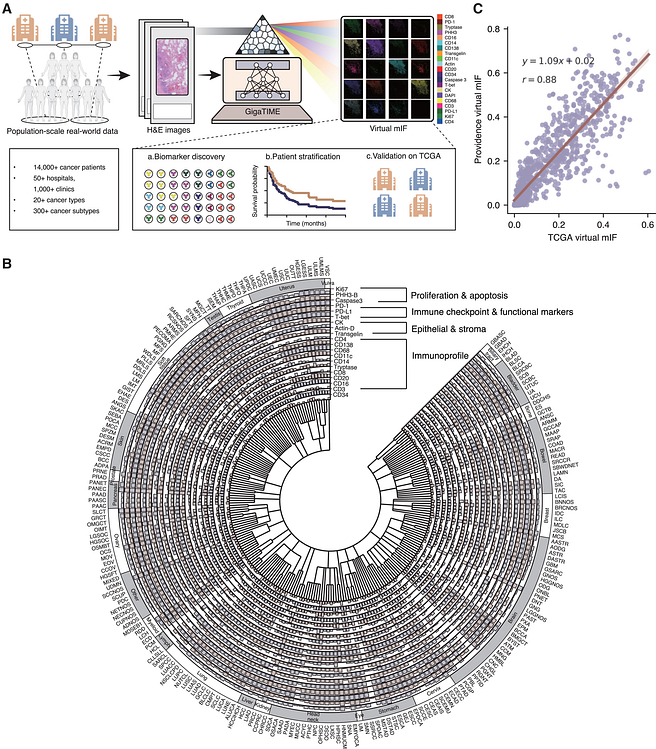
The core job: take a routine H&E pathology slide and translate it into a virtual mIF image across 21 protein channels — automatically, at scale, and without the expensive lab work.
The model was trained on 40 million cells with paired H&E and mIF images from Providence’s real-world clinical dataset. It learned the relationship between what cells look like under a basic microscope and what their protein activation states actually are.
That’s the translation: cell morphology in, molecular signaling out.

The Three Problems It Solves
1. Cost and access
Multiplex immunofluorescence is expensive and scarce. Most hospitals in the world cannot run it. GigaTIME converts a slide that already exists — the $5 H&E slide — into a virtual mIF that captures the same spatial proteomics information. The advanced insight becomes available to any facility that can produce a routine pathology sample.
2. Scale
Even the best-resourced labs can only run mIF on a tiny fraction of their samples. GigaTIME was applied to 14,256 patients across 51 hospitals and over 1,000 clinics within the Providence system. That generated a virtual population of roughly 300,000 mIF images spanning 24 cancer types and 306 cancer subtypes. That kind of population-scale study of the tumor immune microenvironment through spatial proteomics has never been done before — because the data never existed at that scale.
3. Discovery
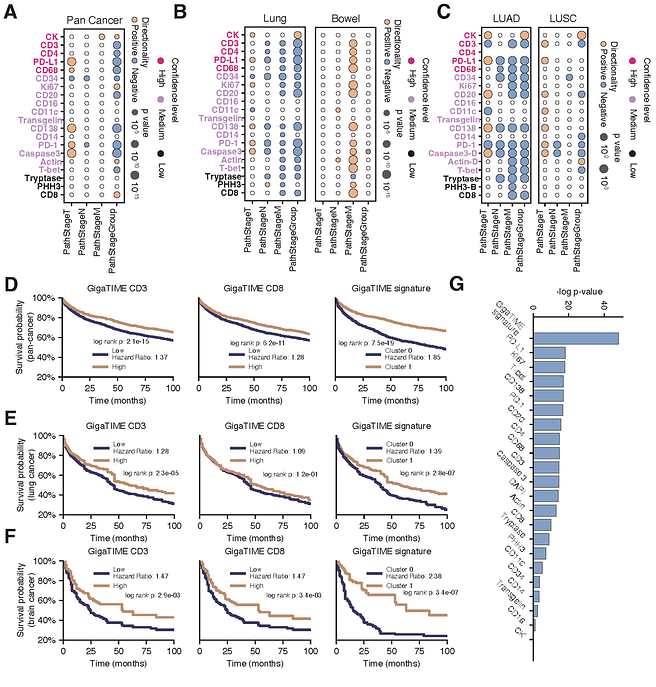
With that virtual population, the research team uncovered 1,234 statistically significant associations linking immune protein activations with clinical biomarkers, staging, and patient survival. Many of these connections — between immune signals like CD138, CD20, and CD4 and tumor biomarkers like KRAS and KMT2D — were previously unknown because the test was simply too expensive to run at the scale needed to find them.
Independent external validation on 10,200 patients from The Cancer Genome Atlas confirmed the findings, with a Spearman correlation of 0.88 for virtual protein activations across cancer subtypes.
Why This Matters for Immunotherapy
Immunotherapy is one of the most promising cancer treatment approaches — it uses the patient’s own immune system to fight the tumor. But the critical challenge has always been identifying which patients will actually respond.
The tumor microenvironment holds the answer. If immune cells are actively engaging the tumor (a “hot” microenvironment), immunotherapy is more likely to work. If the tumor has suppressed the immune response (a “cold” microenvironment), a different strategy may be needed.
Until now, reading that microenvironment at single-cell resolution required mIF — the thousands-of-dollars-per-sample test. GigaTIME makes that read available from a slide that costs less than a cup of coffee.
“GigaTIME is about unlocking insights that were previously out of reach. It has the potential to accelerate discoveries that will shape the future of precision oncology and improve patient outcomes.”
— Carlo Bifulco, MD, Chief Medical Officer of Providence Genomics
What the Virtual Population Uncovered
The research team didn’t just validate the model. They used it to find things that were invisible before.
At the pan-cancer level, the virtual population revealed associations between immune activations and key tumor biomarkers — including previously unknown connections between the tumor suppressor KMT2D, the oncogene KRAS, and specific immune protein channels.
The team also found that combining all 21 GigaTIME protein channels into a composite signature produced significantly better patient stratification for survival prediction than any individual marker like CD3 or CD8 alone.
They discovered non-linear interactions across protein channels, revealing spatial patterns (measured through entropy, signal-to-noise ratio, and sharpness) that correlated with clinical biomarkers. Combinations like CD138/CD68 and PD-L1/Caspase 3 showed substantially stronger associations than either channel individually.
These combinatorial studies were previously impossible given how scarce mIF data was. The virtual population made them tractable for the first time.
The Collaboration Behind It
🏥 Providence Health & Services
Contributed the paired H&E/mIF training dataset from 51 hospitals and 1,000+ clinics — the real-world clinical foundation the model was built on.
🎓 University of Washington
Co-developed the multimodal AI architecture through the Paul G. Allen School of Computer Science & Engineering.
💻 Microsoft Research
Built on their foundation model work including GigaPath and BiomedCLIP, providing the AI infrastructure and making GigaTIME publicly available through Foundry Labs and Hugging Face.
What GigaTIME Means for Builders and Researchers
GigaTIME isn’t a closed research project. It’s open-source and publicly available. The practical implications run across several areas.
For oncology researchers, it means population-scale tumor microenvironment analysis is now possible using slides that already exist in hospital archives. For pharmaceutical companies, it means virtual populations can be generated for drug development studies without the cost barrier of physical mIF. For hospitals in low-resource settings, it means access to spatial proteomics insights that were previously limited to a handful of advanced research centers.
The model can also be extended. The research team notes that GigaTIME can handle more spatial modalities and cell-state channels, and can be integrated into frameworks like LLaVA-Med for conversational analysis of pathology data.
The Bigger Picture
GigaTIME represents a step toward what the research team calls a “virtual patient” — a high-fidelity digital twin that could forecast disease progression and predict treatment response. By translating cheap, routine data into expensive, high-resolution molecular signals, it demonstrates how multimodal AI can scale real-world evidence generation in ways that were previously cost-prohibitive.
Get Started
The digital pathology AI market is projected to exceed $8 billion by 2030. The companies, labs, and health systems building fluency in AI-powered spatial proteomics now — understanding how models like GigaTIME connect to immunotherapy pipelines, drug development, and clinical decision-making — are positioning themselves at the infrastructure layer of precision oncology.
GigaTIME is free and open-source. The model is available on Hugging Face and Microsoft Foundry Labs. The research paper is published in Cell.
The window to build on it before it becomes standard is open right now.
Discover more at the intersection of AI and healthcare with AIHealthTech Insider delivered every Monday, free to read. Click here to subscribe.