Every Sunday, we publish a fast, signal‑dense briefing on the biggest shifts in AI, jobs, and builders. If you want this in your inbox, Join the Sunday Special.
Something strange happened this week. The AI assistants you’ve been prompting for answers suddenly stopped answering — and started doing.
Claude opened your spreadsheets while you were at lunch. Shopify stores started selling inside ChatGPT without a single line of integration code. And McKinsey dropped a warning so blunt it should be printed on every CIO’s desk: deploy agents without redesigning your work, and you’ll break, not scale.

This isn’t incremental progress. This is the inflection point where AI moved from consultant to coworker. Here’s what changed, why it matters, and what you need to do before Monday.
1. Claude Just Took the Keys to Your Mac
Anthropic shipped two features this week that quietly redefine what “AI assistant” means. Computer Use lets Claude operate your Mac — opening apps, navigating browsers, filling spreadsheets, running dev tools — while you’re somewhere else.
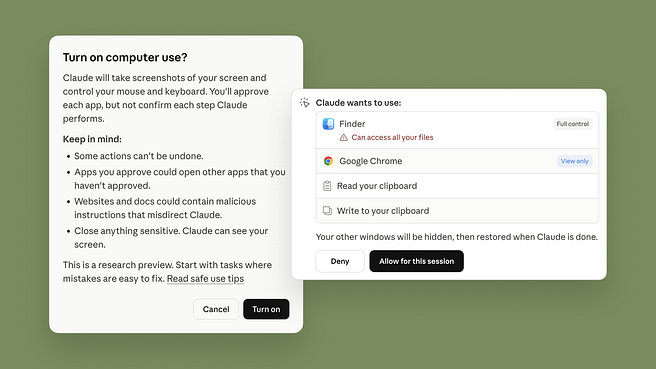
Dispatch turns your phone into a remote control for your desktop: text a task, walk away, return to completed work.
This isn’t screen-sharing. This isn’t “here’s the code, you run it.” Claude actually uses your computer the way you do. It clicks menus. It types into fields. It waits for pages to load. It handles errors. And it does all of this locally — nothing moves to the cloud unless you tell it to.
Why This Changes Everything
Before this week, AI could tell you how to do something. Now it can just do it.
The implications are immediate:
- Developers can start a Claude Code session on their Mac, leave the office, and continue debugging from their phone on the train.
- Operators can text “pull last week’s sales data into a pivot table” and come back to a finished report.
- Researchers can ask Claude to open ten tabs, extract data from each, and consolidate findings into a doc — no manual copy-paste.
Anthropic’s safeguards prevent Claude from opening financial apps or executing trades without explicit permission, but the capability is there. For the first time, you’re not prompting a chatbot. You’re delegating to an employee who happens to be software.
The move: Enable Computer Use in Settings > General. Grant accessibility permissions. Start with one repetitive task you hate — data entry, file organization, report generation — and let Claude handle it end-to-end. Watch what happens to your afternoon.
2. Your Next Customer Might Never Visit Your Website
Starting March 24, every one of Shopify’s 5.6 million stores became shoppable inside ChatGPT, Gemini, Google AI Mode, and Microsoft Copilot by default. No apps. No integrations. No ad spend. A shopper asks an AI for a product recommendation, your store shows up, they buy — checkout happens on your storefront, but the discovery happened entirely inside an AI chat.
This is not a pilot. This is live. Right now.
The Numbers That Matter
Shopify’s AI-driven traffic is up 7× since January 2025. AI-driven orders are up 11×. The front door to commerce is moving from search bars to chat windows, and Shopify just wired every merchant into that new front door automatically.
Here’s how it works:
- A shopper asks ChatGPT, “Find me a minimalist leather wallet under $80.”
- ChatGPT queries Shopify’s Global Catalog.
- Your product appears with a direct link.
- The shopper clicks, checks out on your site, and you keep all customer data and post-purchase control.
Shopify co-built the Universal Commerce Protocol with Google and major retail partners to make this happen. This isn’t a walled garden. This is an open rail system for AI commerce, and every Shopify merchant is already on it.
What This Means for You
If you’re on Shopify: your products are already discoverable in AI chats. Optimize your product titles and descriptions for natural language queries (“minimalist leather wallet” not “MLW-2024-BLK”).
If you’re not on Shopify: you’re invisible in this new channel. Every AI shopping query is routing traffic to stores you can’t reach with SEO or ads.
The move: Audit your product copy tonight. Rewrite titles and descriptions the way a human would ask for them. Then watch your AI referral traffic spike over the next two weeks.
3. McKinsey’s Warning: Redesign or Break
McKinsey’s latest research on agentic AI is not optimistic about business-as-usual deployments. The message is blunt: adding agents without redesigning how work gets done will create fragile systems disguised as efficient ones.
Here’s the problem nobody’s talking about. Most companies are dropping AI agents into legacy workflows like parachuting soldiers into a war they didn’t train for. The agent can execute the task, but the human decision-making structure around it hasn’t changed. Result? Bottlenecks. Errors. Agents waiting on humans who don’t know how to supervise them.
The Agentic Organization, Actually Defined
McKinsey’s framework is simple but uncomfortable:
- Agents execute. They handle the doing — data entry, research, code generation, ticket resolution.
- Humans decide. They own judgment, exceptions, strategy, and the framing of problems agents solve.
If you automate the doing but leave the deciding unchanged, you don’t get scale. You get a faster path to the same bottlenecks.
The Skill Shift Nobody’s Preparing For
The premium skill in an agentic organization isn’t prompt engineering. It’s problem framing — the ability to break a messy business challenge into clear objectives agents can execute, then coordinate the outputs into coherent decisions.

The move: Map one workflow end-to-end this week. Identify every decision point. Ask: which of these can an agent execute, and which must a human decide? Redesign around that split. Don’t automate first. Redesign first.
The Pattern Across All Three
These aren’t three separate stories. They’re one story told from three angles:
- Claude on your Mac proves AI can do work, not just advise on it.
- Shopify in ChatGPT proves customers will buy through AI, not just search.
- McKinsey’s warning proves you’ll break if you treat agents like faster interns instead of redesigning around them.
The common thread: AI stopped being a tool you use and became a coworker you manage.
That shift changes everything — your workflows, your hiring, your tech stack, your definition of productivity. The companies that win in 2026 won’t be the ones with the best prompts. They’ll be the ones that redesigned work around agents instead of bolting agents onto broken processes.
What to Do Before Monday
Don’t wait for a strategy deck. Start small, start concrete, start today:
- Enable Claude Computer Use on your Mac. Delegate one repetitive task you hate. See what your afternoon looks like without it.
- Audit your product copy (or your client’s). Rewrite for natural language AI queries. Track AI referral traffic for two weeks.
- Map one workflow end-to-end. Separate the doing from the deciding. Redesign around that split before adding any agents.
The future didn’t arrive with a press release. It arrived this week, quietly, in three updates most people scrolled past. The question isn’t whether AI can do your work now. It can.
The question is: are you ready to let it?
Found this useful? Follow The AI Entrepreneurs 👉 Sunday Special for weekly deep dives on AI tools, workflows, and strategy that actually move the needle.
This article is one signal. The Sunday Special tracks them every week.Forward this to one person who’s still prompting AI instead of delegating to it.